Image Source — CERN
A Global Scientific Icon
The largest and most celebrated scientific installation in the world CERN, the "Laboratoire Européen pour la Physique des Particules" (European Laboratory for Particle Physics), has recently added a new facility for public outreach and education. With a footprint of over 7,000 square meters, the Science Gateway features exhibits highlighting the work of CERN in exploring the elementary particles and forces of nature and how these are fundamental to our understanding of the universe.
The most prominent feature of Science Gateway, twin tubular sections emulating sections of the accelerator tunnels, are connected by a covered glass footbridge crossing the main road and tramway serving the main CERN campus. The new structure stands in harmony next to the iconic CERN Globe of Science and Innovation, offering a striking contrast to the more functional aesthetic of the surrounding campus.
The main CERN campus is located near the village of Meyrin, some 10 kilometres west of central Geneva, Switzerland. While this campus hosts many of the smaller particle accelerators and experimental facilities, the two larger accelerators, the 6km circumference Super Proton Synchrotron (SPS) and the 27km circumference Large Hadron Collider (LHC) are hosted in underground tunnels mostly under the nearby French countryside. The plane of the LHC tunnel is tilted by 1.4% to maintain a depth of around 100m as the terrain rises into the Jura mountains. There are eight access shafts, and four major experiments, where the results of the focused collisions of sub-atomic particles are captured and studied.
The scale of the LHC and its experiments is staggering. The experimental caverns are large enough to fit cathedrals, with the experiments themselves weigh as much as three Eiffel Towers.
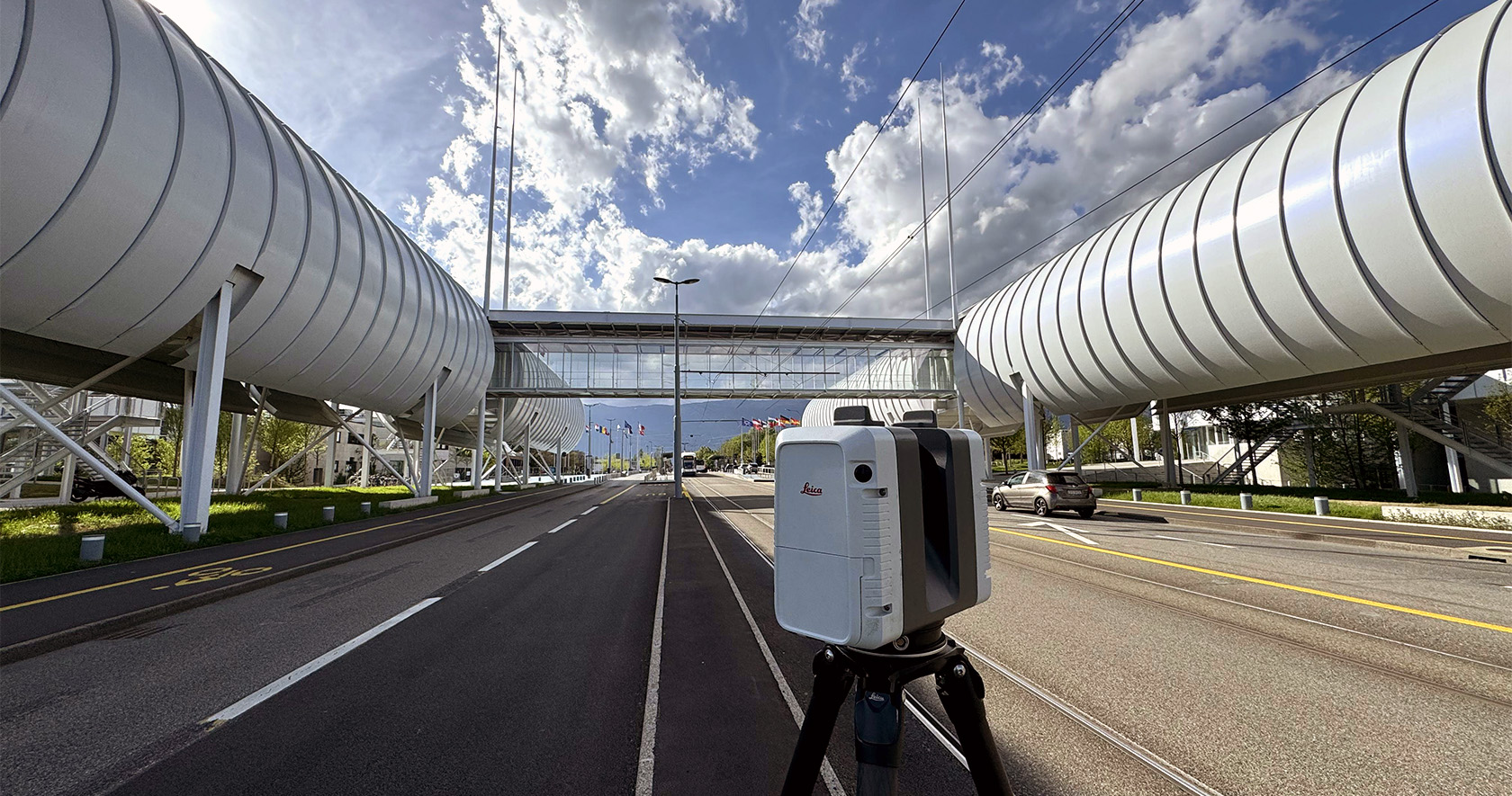
Image Source — CERN
Large Scale Metrology
The Geodetic Metrology Group within the CERN Beams Department provides the metrology, survey and alignment needs for all the components installed in the accelerators and their experiments. The team employs both conventional survey and alignment solutions, and dedicated systems installed on the most critical components, such as stretched wire and hydrostatic levelling systems. These bespoke systems are sensitive enough to register displacements due to earthquakes occurring on the other side of the world.
In addition to accelerator alignment, the survey teams are often called upon to apply their expertise in other areas, most recently performing the as-built survey of the new Science Gateway.
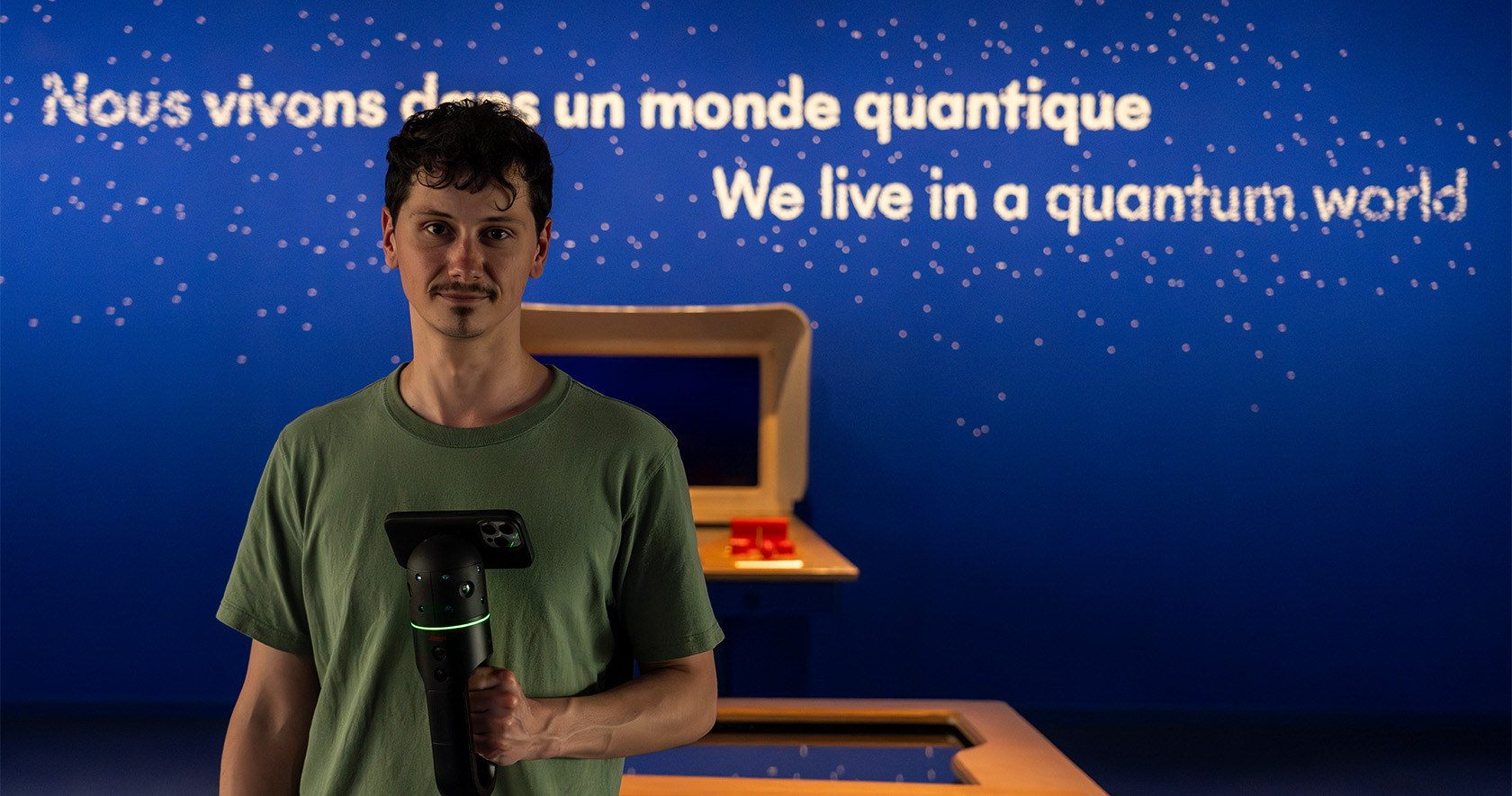
“I'm in the BEAMS department, Geodetic Metrology group, specifically the Accelerator Survey & Geodetic Measurements section,” said Kacper Widuch, a CERN surveying engineer. “My section of 15 people oversees all measurement and alignment tasks related to nearly 64 km of accelerator lines. We also handle high-accuracy point cloud data acquisition for studies, quality control, and as-built measurements of beam components, accelerator areas, and surface buildings.”
Kacper adds that “to align these kinds of machines we also have to take care of the preliminary measurements, like dimensional control of newly arrived components or fiducialisations. It's a measurement linking the external geometry of a component, with internal geometry. It’s extremely important since the magnets must be maintained within ±0.2mm tolerance from the so-called Smooth Curve along the entire LHC.”
“The whole group is around 60 people. It's not only surveyors, we have mechanical engineers, electronics engineers, mechatronics specialists, and IT personnel, but still, the core is around surveying,” said Widuch.
Survey support for the experiments above ground and auxiliary facilities, provides the group with opportunities to step beyond their usual metrological activities. The new Science Gateway generated a lot of excitement across the whole of CERN, and this was equally true for Widuch’s group, as they would be able to use its construction to try out some new spatial measurement technologies.
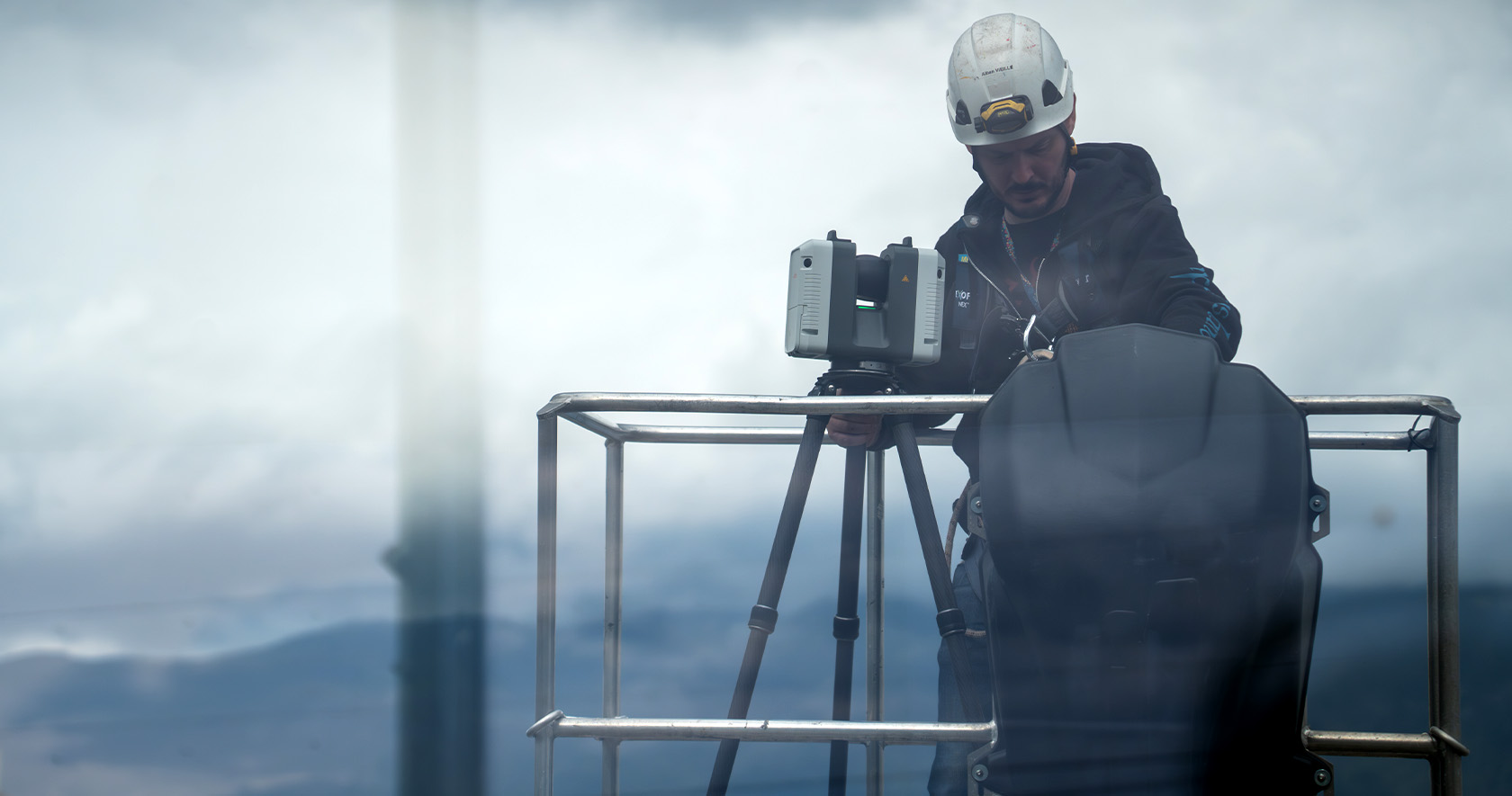
Image Source — CERN
Integrating Reality Capture
“It was very important to have a 3D model of the Gateway, to check the fidelity to the design, but also for planning,” said Widuch. “For instance, if we wanted to change something, or for exhibitions and facility rentals to plan the use of the spaces. It’s also for the facility management. Sure, if you have a 2D plan, you can do whatever you want. But if you can see that in 3D, even as a point cloud, even better as a 3D model, it just brings you closer to the situation you want to represent. We have blueprints, but it is much easier and more effective to work in a 3D model.”
Widuch remarked that “there was no comprehensive as-built modelling done before, often just key measurements. We wanted to learn how to adopt proper reality capture, not just for the Science Gateway, but perhaps for more facilities moving forward. We chose the reality capture solutions from Leica Geosystems as there is a wide variety to try.”
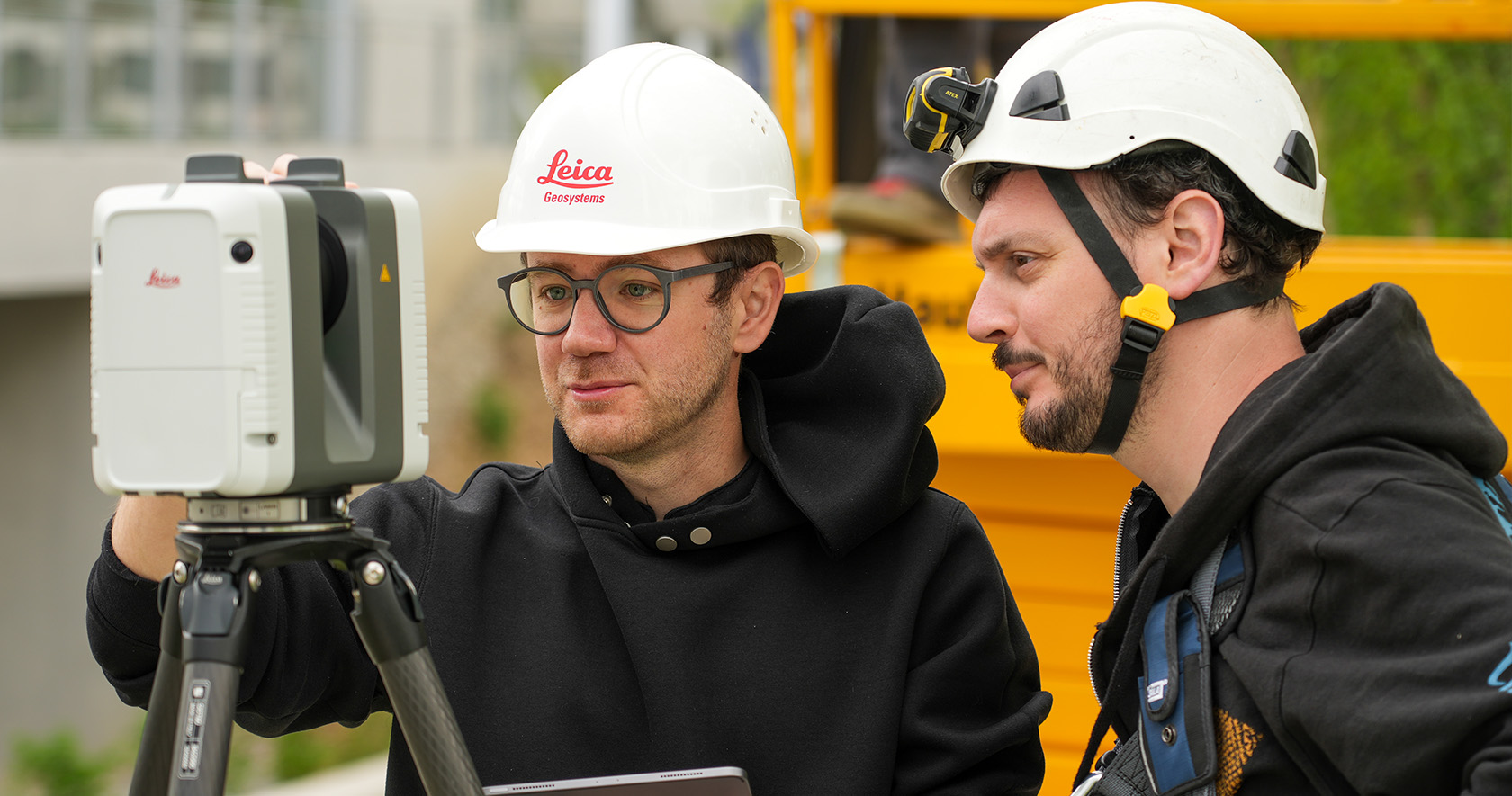
Image Source — CERN
The team scanned the Science Gateway with the Leica RTC360, a terrestrial scanner that automates the pre-registration of point clouds from successive setups using its built-in, Visual Inertial System (VIS) technology. Scanning at up to 2 million points per second, at a range of 0.5m to 130m, the RTC360 had no problem capturing the fine details of the facility. It can also capture a spherical image of high-resolution images in less than a minute at each setup – great for as-built documentation – and the images are used to add full colour to the point clouds. The scanner is easily operated on a tablet or smartphone with the Leica Cyclone FIELD 360 application. This intuitive mobile app provides an immediate preview of captured data and allows for setup linking and point cloud registration, all in the field.
“We did exterior scans with the RTC360, some measurements inside, and especially for external links, to bridge between the interior and exterior,” said Widuch. “For the interior, we used additional reality capture solutions, including mobile scanning devices, the Leica BLK360 and Leica BLK2GO. We also used the Leica BLK ARC autonomous laser scanning module combined with robotic carrier, the Boston Dynamics Spot. It was great to experiment with all the laser scanning devices and see how each could be best applied. The devices, paired with in-field applications, Leica Cyclone FIELD 360 and the Leica BLK Live app greatly improved our speed and overall efficiency. Doing what we did with traditional laser scanning methods would have taken much more time.”
“It was super interesting to see how the reality capture instruments did on Science Gateway, especially because it is not a simple structure,” said Widuch. “There are a lot of glass-enclosed spaces, lots of glass corridors and passageways. Also, just the geometry, and the cylindricity of those two exposition spaces. It is something that you don't think of when you think of a building, nothing like the typical cubic shape. Plus, there is a plethora of visible steel construction elements.”
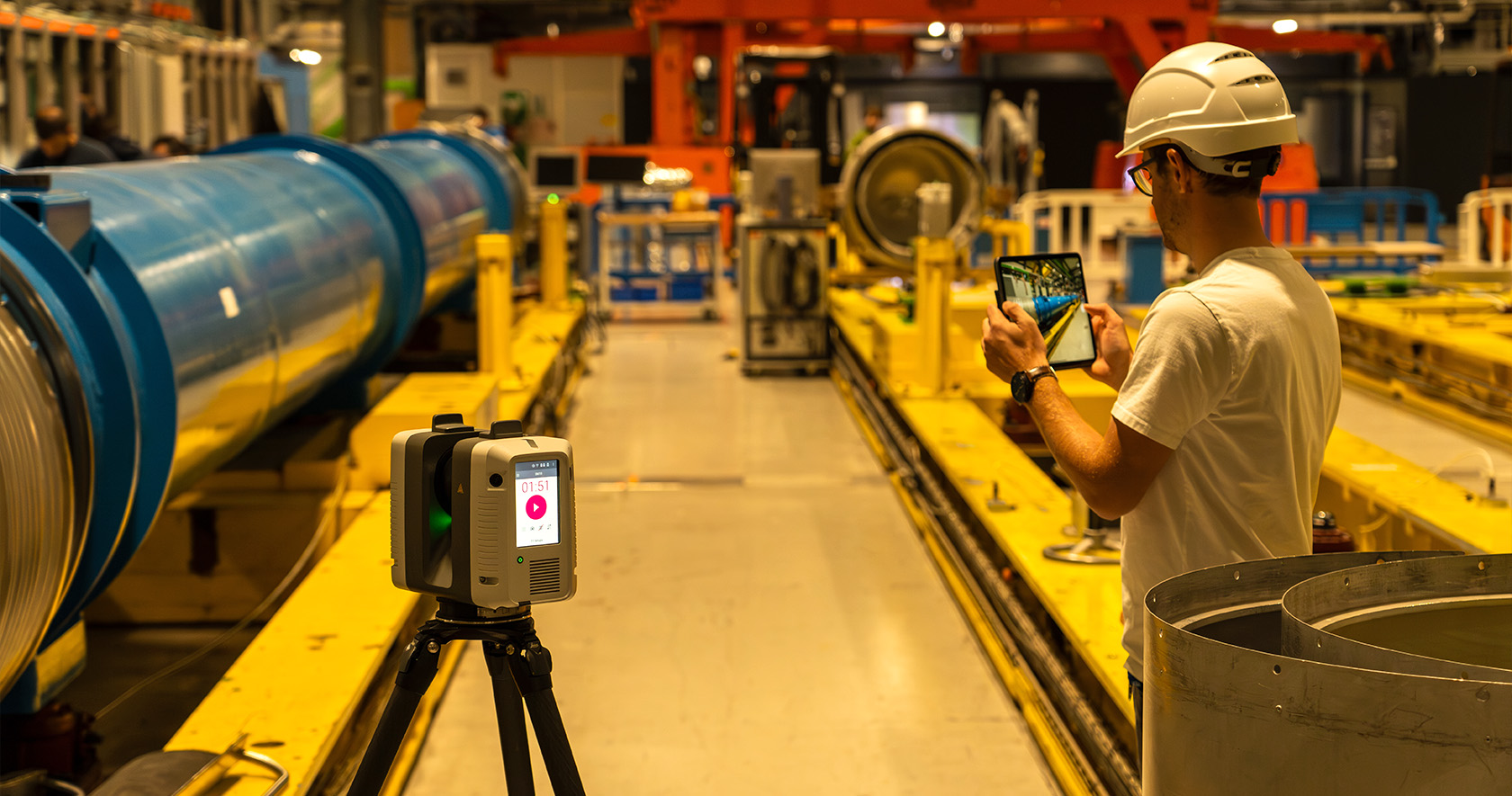
Image Source — CERN
Expanded Opportunities
The CERN survey team also had the opportunity to try out these instruments for reality capture in a laboratory setting. “SM18 is a magnet test facility. It also houses the IT String (Inner Triplet) test,” said Widuch. “It's a mock-up, a demonstration of almost 100 meters of installation that will take place in the LHC tunnel for the High-Luminosity project. The High-Luminosity Large Hadron Collider (HL-LHC) project is designed to enhance the LHC's performance, aiming to boost discovery opportunities after 2029. So, the magnets, the secondary components and all of the installations that are there (currently in the tunnel), cryogenics, electrical installations, it's all going to be removed and we're going to replace it with a new generation,” continues Widuch. “It's an upgrade of the hardware and the associated software. Having a 3D model could be very helpful not just as an as-built, but also gives us experience in 3D scanning and imaging capabilities for all kinds of tunnel infrastructure”.
“3D modelling of these buildings was a fun jump for our team, a change from the micrometric measurements we are used to doing. It was educational as well; thinking about how we might also be able to employ such solutions for other facilities and perhaps someday the infrastructure in the tunnel.”
And what might the future hold? The design of a proposed 91-kilometre circumference collider at CERN is undergoing a feasibility study. What role might reality capture, digital twins, and construction automation systems play in such a project? Might future reality capture sensors leverage quantum technology? Remember, CERN was the birthplace of the World Wide Web; who’s to say what’s next?
Explore the CERN Science Gateway digital twin in the video below.