High Speed Two (HS2) is set to be the future of Britain’s rail network, cutting travel time between the country’s two biggest cities, Birmingham and London, to under an hour. This national infrastructure project promises shorter journeys, improved transport links, new jobs, and lasting reductions in emissions.
Delivering on those promises is no small feat, especially in the capital. The main HS2 tunnel section is a 13-mile stretch from Euston in central London to West Ruislip in far North West London. The tunnels’ construction was entrusted to the Skanska Costain STRABAG Joint Venture (SCS JV) and presented a significant engineering challenge. Unlike conventional tunnelling projects driven by a single machine, the Northolt Tunnels section required four tunnel boring machines (TBMs) to operate simultaneously, converging into a set of twin-bore steel pressure vessels, accessed by two large ventilation shafts.

The survey team's job was to guide four tunnel boring machines (TBMs), such as the smaller diameter one pictured here that was used for the Atlas Road Logistics Tunnel.
Digging this tunnel from both sides and getting them to meet in the middle is “like trying to hit a 10 pence coin from 8 kilometres away,” said Matthew Baddeley, survey manager at SCS JV.
That wasn’t the only monumental surveying challenge during construction. Another was ensuring the tunnel sections were built exactly as designed. To achieve this, the SCS JV surveying team established and captured detailed as-built data throughout construction. Using Leica Geosystems technology, they delivered 3D scans of the tunnel linings, cross passages, and walkways to the engineers and designers. These scans were compared with the original design models to verify accuracy at every stage while maintaining strict safety and precision standards.
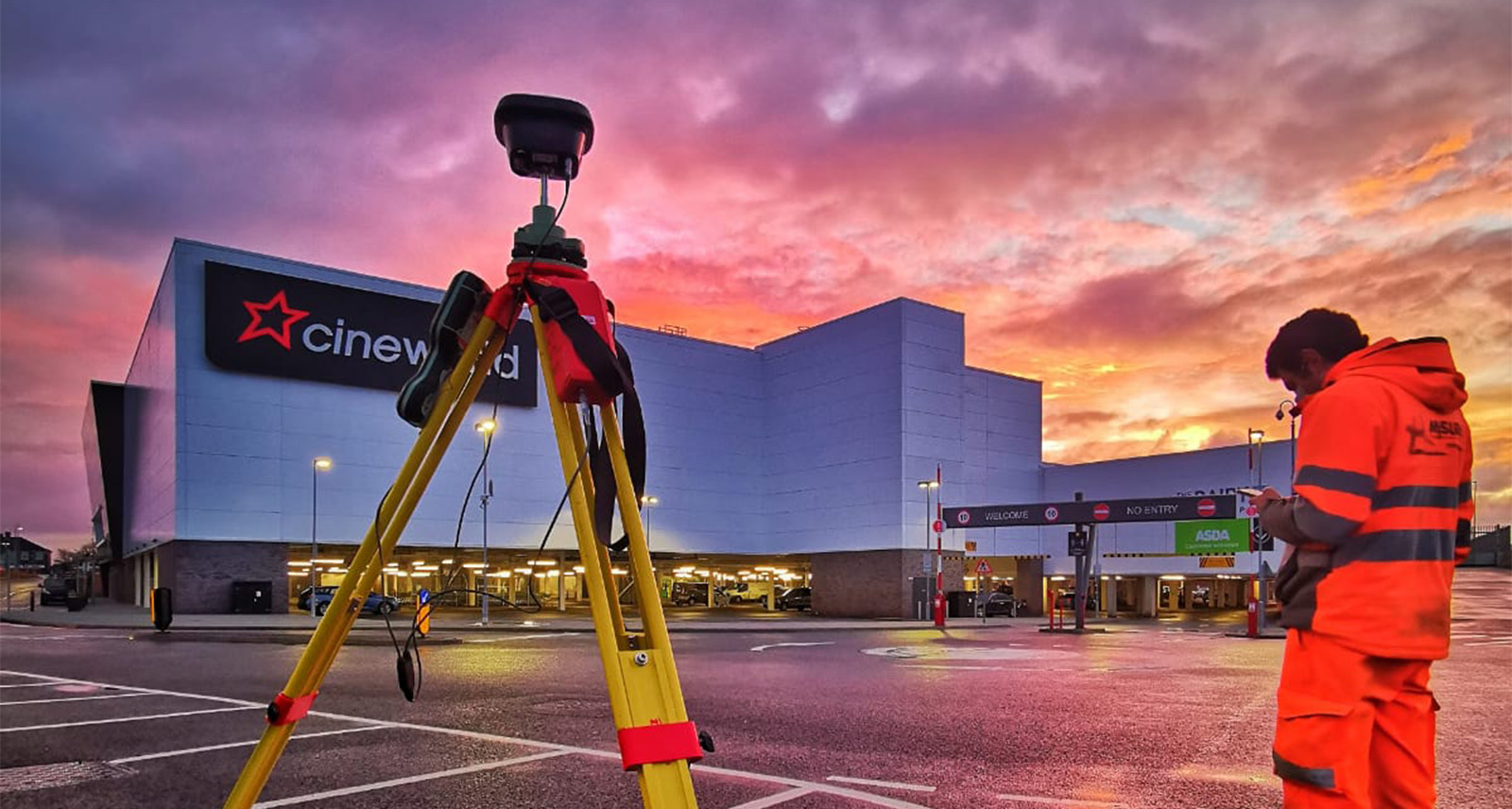
It wasn't all laser scanning. The SCS JV surveying team relied on a variety of Leica Geosystems technologies, such as Leica GS16 and Leica GS18 to establish control networks.
A tunnelling challenge on a new scale
Surveying the tunnels brought unique challenges. The project demanded combined production: as the machines advanced, crews were also constructing inverts, cross passages and walkways behind them.
The task was complicated by a multitude of factors, including restrictions on traversing under live conveyor systems and refraction issues that could distort measurements due to varying temperatures inside the tunnels.
Countering this required creating a tunnel network of diagonally braced control measurements that carefully avoided observations along tunnel walls, where refraction effects are most uncertain. Observations were also paused during periods of major plant movements and heavy dust.
Bespoke tunnel brackets were designed by the survey team that could mount a total station, such as a Leica TS60. These tunnel brackets had to be extremely robust, match the angle of the tunnel rings at a pre-defined elevation, and 50% of them had to be shortened so that the invert concrete bridges could pass without clashing. Off-the-shelf instrument wall brackets were modified to turn them into TBM guidance brackets to allow secure drilling into the tunnel lining.
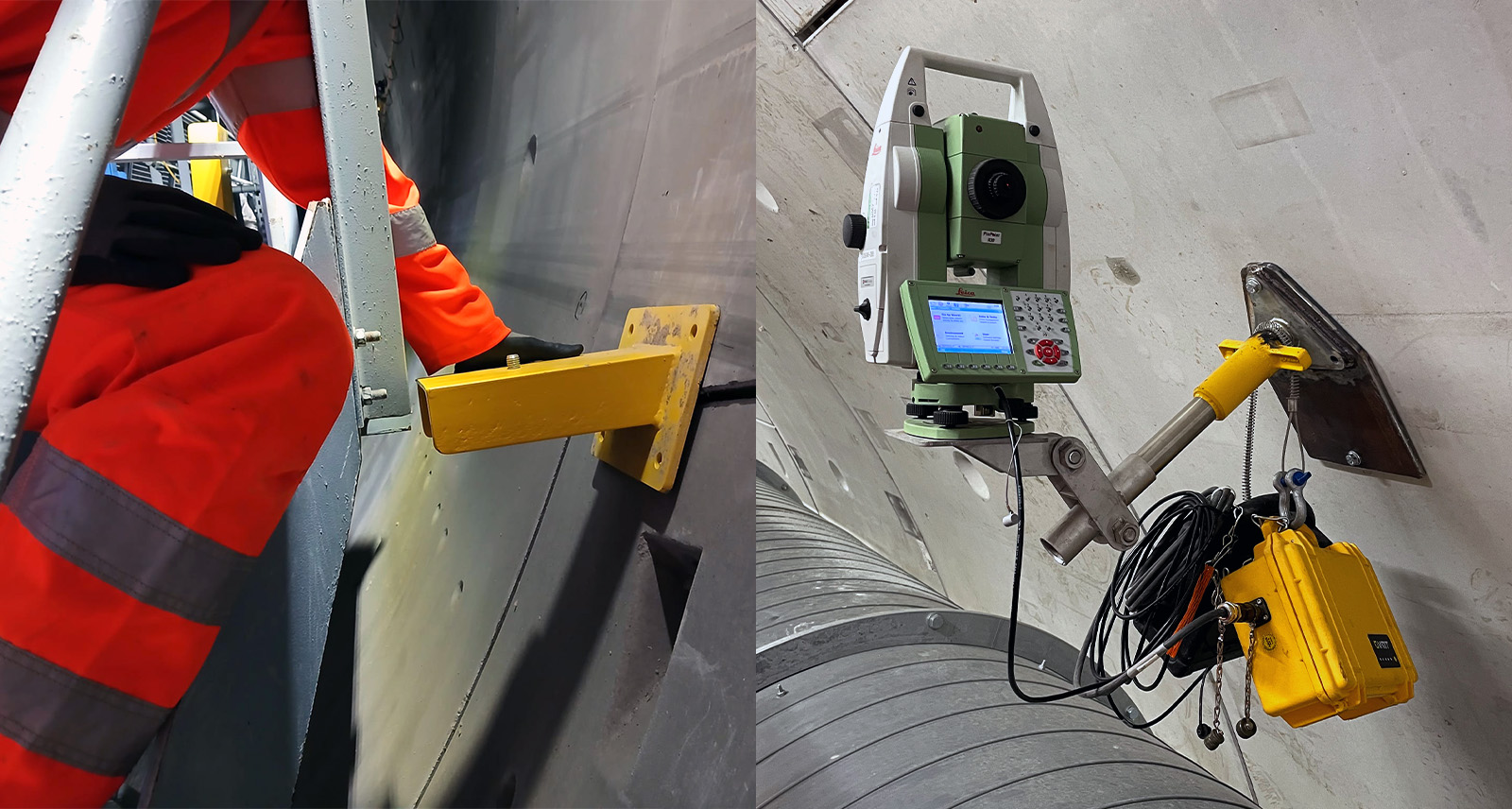
The survey team designed a bespoke tunnel bracket system for the Leica TS60 to avoid clasheswith obstructions. Off-the-sheld wall-mounted brackets were modified to enable use as TBM guidance brackets.
Scanning the way forward
The laser scanning process involved the Leica RTC360, which carried out two to three scans on either side of a new cross passage to produce a point cloud, providing an accurate 3D model of the concrete tunnel rings for progress validation and design verification.
The Leica RTC360 also proved invaluable for its speed and portability. “The RTC360 is light, compact, and captures both scans and imagery in just three minutes,” added Baddeley. “It’s great when you’re working 8 kilometres underground. It gives us exactly the accuracy we need, producing that final ‘glossy’ as-built that's delivered to our stakeholders.”
Importantly, both experienced surveyors and apprentices could use it confidently. “It’s intuitive to use as well, providing the younger team members are well mentored on survey control and geometry best practice, they can run the scanners on site, so people like myself can spend more time analysing and post-processing the data in the office. It’s a natural progression from field to office,” Baddeley explained.

"The Leica RTC360 is light, compact, and captures both scans and images in under three minutes - it gives us exactly the accuracy we need."
For progressive scanning, the team turned to the Leica Nova MS60 MultiStation. This was useful behind the TBMs, where full ring profiles had to be captured quickly before the first stage concrete was poured. “The MS60 is perfect for progressive as-builts. We can set it up behind the TBM, carry out a resection, scan a complete tunnel ring profile, and instantly generate a discrepancy report to share in a meeting,” Baddeley said. “It’s lightweight, fast, and the files are easy to work with, which makes it a great fit for this kind of work.”
The team created a survey process that gave designers confidence in the data, keeping construction on track. In fact, there were initial concerns about scanning every single stage of the tunnels. But Baddeley noted that these were quickly addressed: “At first, people were a bit sceptical about scanning everything in 3D, but now it’s become second nature. Once everyone saw how much time it saved, they were fully on board.”
The rooftop traverse
Even the most precise laser scans would be meaningless without a trusted control network to anchor them. Every resection, point cloud, and ring extraction needed to reference the same grid - HS2 Survey Grid.
To validate this wider network, the team conducted an 8-kilometre rooftop traverse between two stations: Old Oak Common and Euston. This was essential to verify the horizontal connection between the two sites, check for scale errors in the project grid, and confirm the reliability of the original static GNSS baselines established one to two years earlier.
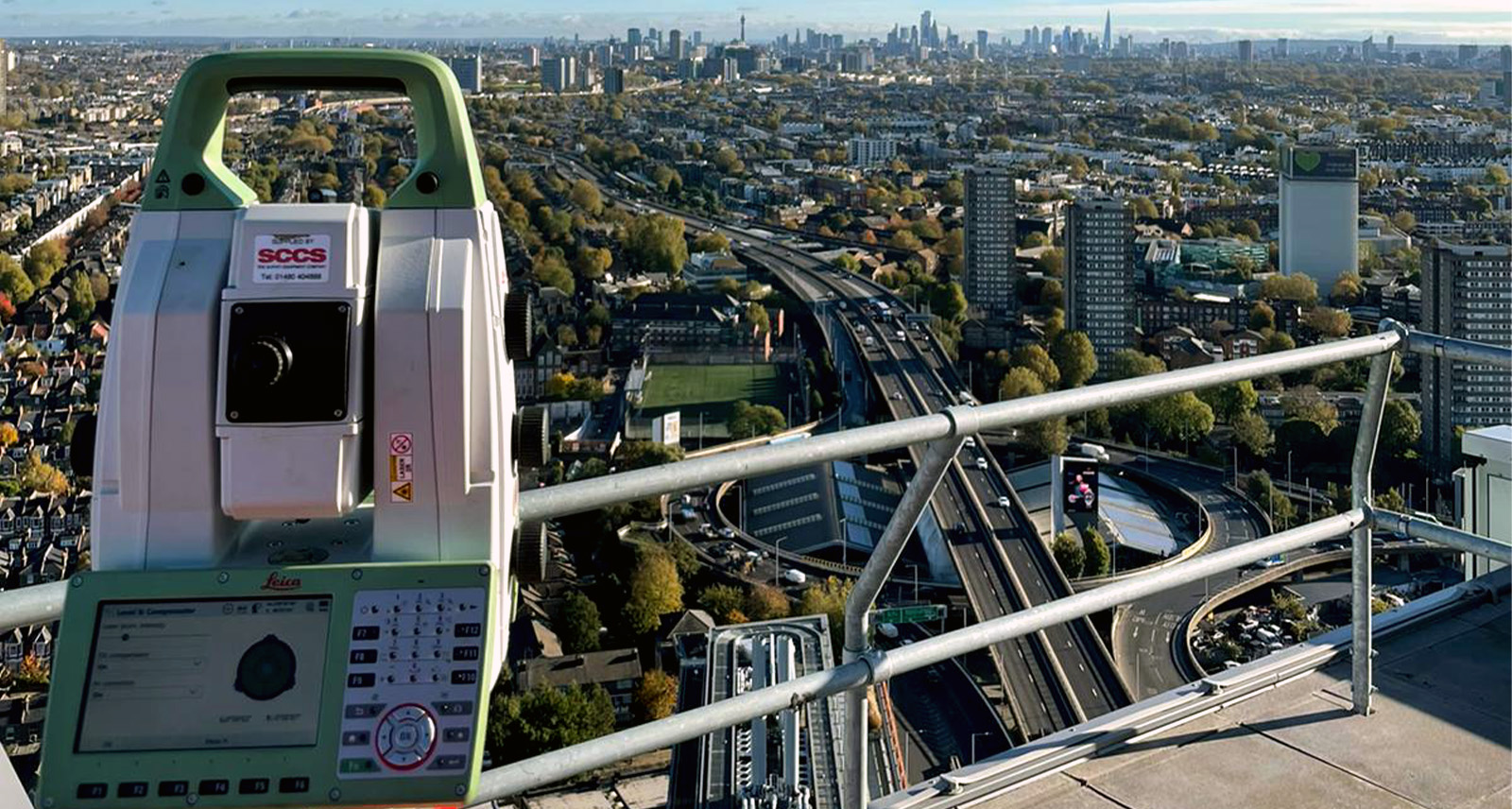
During the rooftop traverse, the team managed to exceed the total station's specified range by closely monitoring environmental conditions and adjusting settings accordingly.
“With the Leica TS60 and Leica GPH1P prisms, we were able to maintain reliable ATR (automatic target recognition) lock beyond the 1,500-metre specification,” said Baddeley.
Conditions like temperature, pressure, and humidity were monitored and re-entered into the total station every half hour to achieve this level of accuracy. “With 1°C over 1 kilometre equating to a millimetre of error, even small fluctuations mattered,” explained Baddeley.
Despite tricky access and low-light weather conditions, the team delivered an accurate traverse that gave the team confidence in breakthrough tolerances.
"Leica Cyclone 3DR is like the Swiss Army knife of scanning software."
From point clouds to progress checks
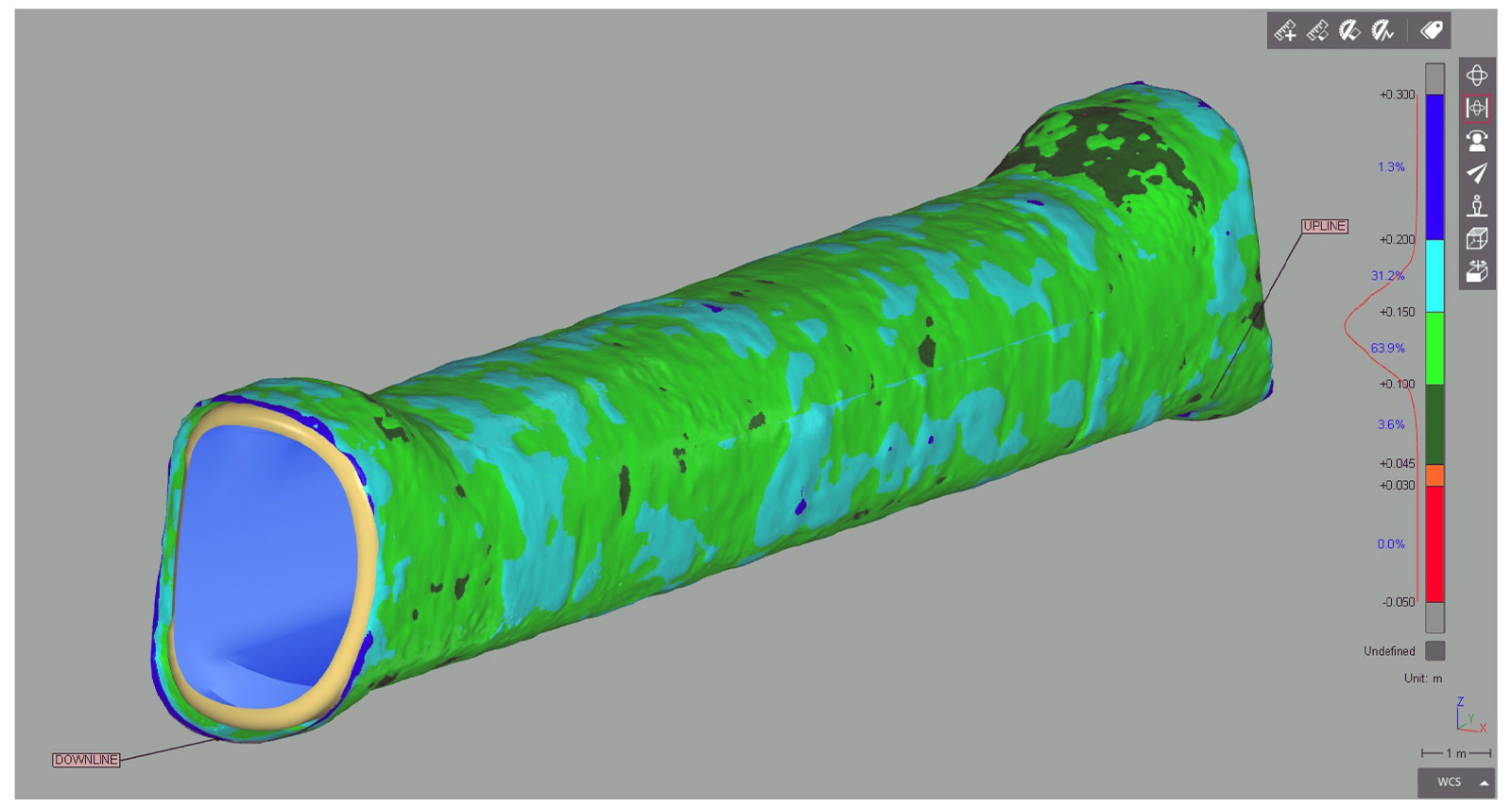
After scanning, the data is uploaded to Leica Cyclone 3DR, where the team can extract the tunnel rings as high-density 3D point clouds. These are then processed into an updated as-built model for comparison with the original design model.
“It’s very easy to import data into Cyclone 3DR. You can pull in so many different types of design data into Cyclone 3DR. For example, you can import IFC and IGS formats, and then easily export to DXF to bring the linework into CAD. The analysis tools are intuitive and straightforward, so people pick them up quickly. Once the design is in 3DR, you can quickly run a comparison, load the right scale, and generate a report. It’s fast, and it handles large datasets with no problem.”
Another highlight of Cyclone 3DR is how customisable it is. “One of my colleagues recently used a script in Cyclone 3DR to calculate the volume of first-stage concrete that was out of tolerance, which was incredibly powerful.”
“Leica Cyclone 3DR is like the Swiss Army knife of scanning software,” praised Baddeley.
The team also found value in sharing the scan data more broadly by uploading everything to Leica Cyclone ENTERPRISE. “Once the data was uploaded to Cyclone ENTERPRISE, engineers and designers could access it directly, extracting coordinates for grout port positions or drainage layouts without needing us to remeasure on site and reducing the people/plant interface on site,” explained Baddeley.
This demonstrates that the value of 3D data extends beyond just its primary intended purpose. Underpinning this process, Leica Infinity software ensured the post-processed static GNSS survey baselines and resulting survey control framework behind all laser scanning campaigns were rock-solid. Static GNSS observations were collected simultaneously for at least 6 hours and then post-processed in Leica Infinity to produce long, accurate baselines across the project, ensuring every point cloud was accurately georeferenced to the trusted HS2 project coordinate system.
Precision and pride
The scanning produced a highly accurate 3D point cloud, enabling the team to verify progress against the design tunnel alignment, spot discrepancies early, and confidently guide the TBMs to complete the tunnels on target, achieving millimetre-level breakthroughs for Northolt Tunnels East.
For the surveying team, moments of breakthrough were both nerve-racking and immensely rewarding. “Those final deviation measurements can only be made once the TBM breaks through, so there’s a huge sense of relief when it all aligns,” said Baddeley. The knowledge that the control network and daily measurements had held gave the team real pride.
“Completing the rooftop traverse was a real high point, as were the breakthroughs themselves,” reflected Baddeley. “But for me, the best part has been seeing the team grow through the process.”
The HS2 London Tunnels project shows how Leica Geosystems technology provides survey teams with the accuracy and confidence needed to guide tunnel breakthroughs and verify construction.
To learn more about how Leica Geosystems technology supports complex infrastructure projects through precision and reliability, contact us here.